When you receive a serious diagnosis or are offered brain or spinal surgery, it is natural to want another specialist's view. A second opinion is not a sign of distrust in your treating doctor. It is a common medical practice that can help you understand your situation and make an informed decision.
When a second opinion is useful
A further neurosurgical assessment may be particularly helpful when:
- you have been offered surgery and want to understand all the options;
- the diagnosis is rare, complex or has important consequences;
- you have received different recommendations from different doctors;
- your symptoms do not seem to match the imaging report;
- treatment has not produced the expected result.
The right to another medical opinion
In Romania, Law No. 46/2003 on patients' rights explicitly provides the right to request and obtain another medical opinion. Article 12 provides, in the context of hospital discharge, for a copy of recordings from advanced imaging investigations to be supplied once, on request. It is therefore important to keep the CD or DVD you receive safely and make a backup copy.
Why the images matter, not just the report
The radiology report is a written summary. For a neurosurgical decision, the doctor needs to see the actual images and relate them to your symptoms and clinical examination.
Two studies illustrate why this matters:
- In a study published in The Spine Journal, the same patient underwent lumbar spine MRI at 10 different centres within three weeks. The reports varied considerably: no finding was described in all 10 reports, and overall agreement between interpretations was poor.
- A large review of studies in people without pain found that degenerative spinal changes are common and increase with age. For example, disc bulging is seen in around 30% of 20-year-olds and 84% of 80-year-olds. The authors emphasise that these images must be interpreted in the patient's clinical context.
The practical message is straightforward: bring the original images, not only the report.
What DICOM format means
DICOM (Digital Imaging and Communications in Medicine) is the international standard for medical images and their associated information. An MRI or CT study is not a single image. It contains several series, each with tens or hundreds of slices in different planes and sequences.
DICOM files retain all these slices at full quality, together with the necessary technical information. The doctor can scroll through the series, compare sequences, take measurements and reconstruct images in other planes.
A photograph of the screen or a few JPG images show only a small part of the study. They do not allow accurate measurements or assessment of a lesion in every plane.
Which documents to prepare
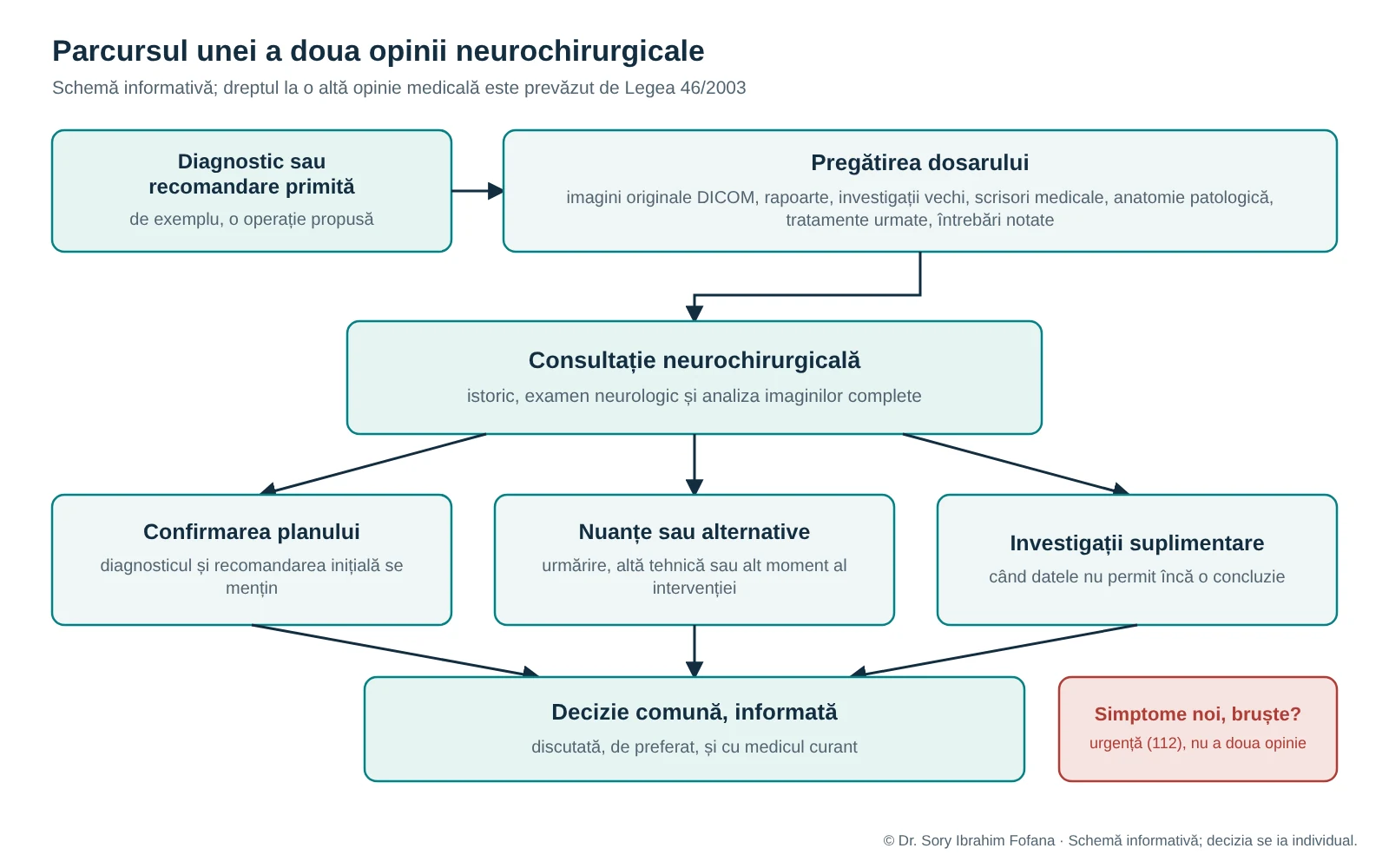
A second opinion is more useful when the information is complete:
- The original MRI or CT images on CD, DVD or USB, in DICOM format. Check beforehand that the medium opens on a computer.
- Reports from all imaging investigations.
- Older investigations, if available. Comparison over time shows whether a lesion is stable or changing.
- Medical letters and discharge summaries, including operative reports if you have had surgery before.
- Histopathology results if a biopsy or operation has been performed.
- A list of treatments so far and your current medicines.
- Your questions, written down beforehand so that nothing important is missed.
Making a decision together
The UK NICE guideline on shared decision making recommends openly discussing the risks, benefits and consequences of each option. Patients should know that options also include having no treatment or continuing their current management. Information is provided in stages, checking understanding along the way.
A risk does not have the same significance for every patient. Occupation, independence, personal goals and individual preferences all matter in the choice.
What a second opinion can realistically offer
A further assessment may confirm the diagnosis and proposed plan. It may add detail or present alternatives, such as monitoring rather than surgery, another surgical technique or different timing. In either case, the final decision belongs to you and is easier to make when you understand the reasoning.
There are also limitations. Images alone cannot replace clinical examination. A complete neurosurgical opinion is therefore formed during a consultation, after the doctor listens to you and examines you. An assessment based solely on images or a report can only provide guidance.
What you should leave the consultation with
- a clear explanation of the diagnosis;
- the options discussed and the reason for the recommendation;
- any further investigations needed;
- a plan: what happens next, within what timeframe and which symptoms require an earlier assessment.
When a second opinion should not delay care
A new seizure, sudden weakness, speech disturbance, confusion or rapidly worsening neurological condition requires emergency assessment. In these situations, call 112 or go to the nearest emergency department.
Discussing it with your treating doctor
It is helpful to tell your treating doctor that you are seeking a second opinion. Most doctors regard this as a normal step. The outcome of the further assessment can then be discussed together to choose the most appropriate treatment plan for you.